


John Vecchi, cloud security evangelist at Mitiga, writes for CISOs and security leaders navigating AI-driven cloud, SaaS, and identity attacks. This article examines the real cost of inaction in 2026 and why Zero-Impact Breach Prevention, powered by AI-native Cloud Detection and Response, is becoming a career-defining mandate.
Key Highlights
- AI attacks are escalating across cloud, SaaS, and identity environments, increasing business impact and executive accountability.
- In 2026, CISOs won’t lose their jobs for a breach, but for failing to detect and contain AI attacks fast enough.
- “No decision” on AI-native Cloud Detection and Response is a decision to accept greater incident impact.
- SaaS sprawl, AI infrastructure, and identity chaos make AI attacks harder to see and contain with legacy tools.
- Zero-Impact Breach Prevention shifts the focus from blocking every intrusion to stopping AI attacks before they cause measurable business harm.
Honest question: what actually puts your job at risk in 2026?
It's not AI. It's not the cloud.
It's being the person in the room who can't explain what happened when an attack gets through and causes impact.
In a world of AI‑driven cloud and SaaS attacks, “No decision” is the new breach.
Not because inaction suddenly results in incidents, but because deferring hard choices about AI-native cloud detection & response (CDR), panoramic visibility, and Zero-Impact Breach Prevention for active threats leaves you exposed to the one outcome you really can't afford: a serious incident you couldn't see or contain – and can't credibly explain.
This post kicks off a new, and what I believe to be very timely, series on The Cost of Inaction in 2026 and what CISOs will actually get fired for in an era defined by AI‑powered cloud threats, vulnerable AI services and infrastructure, relentless SaaS sprawl, and identity chaos. Spoiler alert: it's not “you deployed the wrong product.” It's “you couldn't contain and stop the business impact, and you couldn't tell a defensible story.”
And the number one contributor to that outcome is the quiet, comfortable enemy inside most security programs: no decision.
“No Decision” Is the New Breach
Look at your own security roadmap and pipeline:
On Real-time Cloud Detection and Response
“We've already invested in CrowdStrike, Wiz, Splunk, and more. I need a very clear case that this isn't just overlapping what we already have.”
On SaaS Visibility and Identity Awareness
“Between Okta, Microsoft 365, our IDP, and the SaaS and identity logs we're sending to the SIEM, we're not blind. It may not be perfect, but it feels good enough for now.”
On AI Infrastructure Defense and AI SOC
“Our AI projects are mostly proof of concepts and basic governance and policy pilots. Anything more is hard to justify until AI is a larger part of our risk profile.”
On paper, those calls sound reasonable.
In practice, “no decision” is a very real decision.
- You're deciding to keep flying without real-time visibility across cloud, SaaS, AI, and identity.
- You're deciding that if an attacker uses stolen credentials to bypass your traditional controls in the next six to 12 months, you're okay trying to detect and investigate it with fragmented, uncontextualized logs and guesswork.
- You're deciding that luck and legacy posture-based prevention will outrun stolen identities, SaaS attacks, AI-enabled threat actors, and vulnerable AI infrastructure.
That's the cost of inaction in 2026, a year our Mitiga Labs team is projecting to be the year of the SaaS breach: you're not just delaying a project; you're accepting unbounded incident impact for another year.
What CISOs Will Actually Get Fired for After an AI-Driven SaaS Attack
In the cloud sprawl and AI era, CISOs and security leaders don't lose their jobs because they had an incident or missed one attack.
They lose their jobs because:
1. They got blindsided by something they should have seen coming.
A misconfigured cloud asset, an exploited 3rd-party application, or an abused shadow AI model that was “somebody else's problem” until it wasn't.
2. They couldn't quickly and credibly answer basic questions, like:
- What exactly happened?
- What did it touch – data, systems, customers?
- How long did it last, and how did we contain it?
- What was the impact?
3. They communicated on guesses over evidence.
Board updates filled with “we think” and “we're still investigating,” followed by corrections a week later as the story shifts.
4. They couldn't prove learning.
A second, similar incident exposes that the organization never really fixed the root cause or improved detection, response, and breach prevention for active attacks.
If there's one common thread here, it's a lack of visibility – combined with insufficient forensic context and awareness about their own environment – to manage and stop the impact.
The real cost of inaction in 2026 is whether you can withstand a breach politically, reputationally, and financially when it happens.
Why AI-Driven Cloud, SaaS, and AI Attacks Change the Stakes
In 2026, three forces are colliding in a way that makes indecision and inaction especially dangerous:
SaaS sprawl at enterprise scale
Most enterprises are running more than a handful of strategic SaaS apps now. They're running hundreds across CRM, HR, finance, collaboration, dev tools, and niche line‑of‑business platforms. Each has its own admins, permissions, and APIs, with new apps and integrations coming online every week. Point tools only see slices of this estate and can't keep up with the constantly shifting graph of apps, connectors, tenants, and SaaS identities. The result is that core business processes now live in SaaS platforms your SOC can't see, especially in real time.
AI infrastructure + AI‑enabled adversaries
At the same time, you're wiring AI directly into that sprawl – LLMs, internal copilots, MCP agents, and AI-enhanced SaaS services that touch sensitive data and systems. Those AI services introduce new attack surfaces, open to everything from prompt injection and poisoned data to misconfigured access and exposed keys. On the other side, attackers are using AI to chain reconnaissance, payload generation, privilege abuse, and exfiltration into end‑to‑end, AI‑orchestrated campaigns. The line between "our AI" and “the AI they run against us" gets thinner every day.
Identity chaos: both human and non‑human
Underneath it all sits identity. Employees, external vendors, partners, workload identities, SaaS identities, AI agents – and the ratio of non‑human to human identities is exploding. Each identity carries delegated permissions across multiple cloud and SaaS environments. As a result, identity-related attacks are happening at an unprecedented scale as threat actors use stolen credentials to gain unauthorized access to sensitive data and systems. Very few organizations have a coherent, end‑to‑end view of who can do what, from where, and via which integration. When one identity is compromised, tracing its blast radius across this mesh is nearly impossible without a unified, AI‑native cloud detection and forensic layer.
Together, they change the nature of real-time cloud detection and response:
- Incidents don't stay in one platform; they hop across cloud, SaaS, AI, and identity.
- Signals are less about static signatures and more about behaviors and relationships over time.
- The investigation surface explodes: dozens of services and systems, 100+ raw log sources, multiple identities and tenants.
When 64% of organizations say they have little or no confidence in handling cloud threats, trying to manage AI-driven attacks with limited visibility and manual investigation is a real gamble – and how “no decision” can turn into “no job.”
The New North Star for CISO's and the Modern SOC
If “breach prevention” was the slogan for the last decade, Zero‑Impact Breach Prevention is the mandate for this one.
You're not going to stop every intrusion. Not even close. In a cloud/SaaS/AI world, that's fantasy.
What you can do is design detection, triage, and preemptive prevention so that when (not if) something fails:
- You detect it in seconds or minutes – before it becomes a headline.
- You can reconstruct the full story across cloud, SaaS, identity, and AI.
- You preemptively contain and stop business impact before it becomes a board-level event.
- You can show, with evidence, what happened and what didn't.
Zero‑Impact Breach Prevention doesn't mean “no attacker ever gets in.” It means:
Even when attackers get in, they get nothing that materially harms the business.
That's the outcome your board and CEO will care about in 2026.
Zero-Impact for Cloud Attacks Doesn't Just Happen
Adding another rule pack or yet another point product won't get you to Zero-Impact.
You'll get there by building a safety net of Cyber Resilience underneath your security program:
- Panoramic Awareness: that starts by seeing everything in one place – while connecting Cloud, SaaS, Identity, and AI ecosystems in a single, always-on forensic system.
- Attack Decoding: that automatically and instantly builds the full story from the connected, panoramic view then reconstructs logs and actions into a timeline of the attack – revealing what happened, what it means, and where it's headed next.
- Attack Containment: that lets you stop active cloud and AI attacks mid-flight – autonomously or manually – stopping and reversing any damage to ensure there's no impact.
This is where platforms like Mitiga's AI-native Cloud Detection and Response Platform, powered by a Cloud Forensics Data Lake, come in: not as yet another dashboard, but as the engine that turns raw, chaotic noise into the context, forensic truth, and preemptive breach prevention you'll need on the worst day of your career.
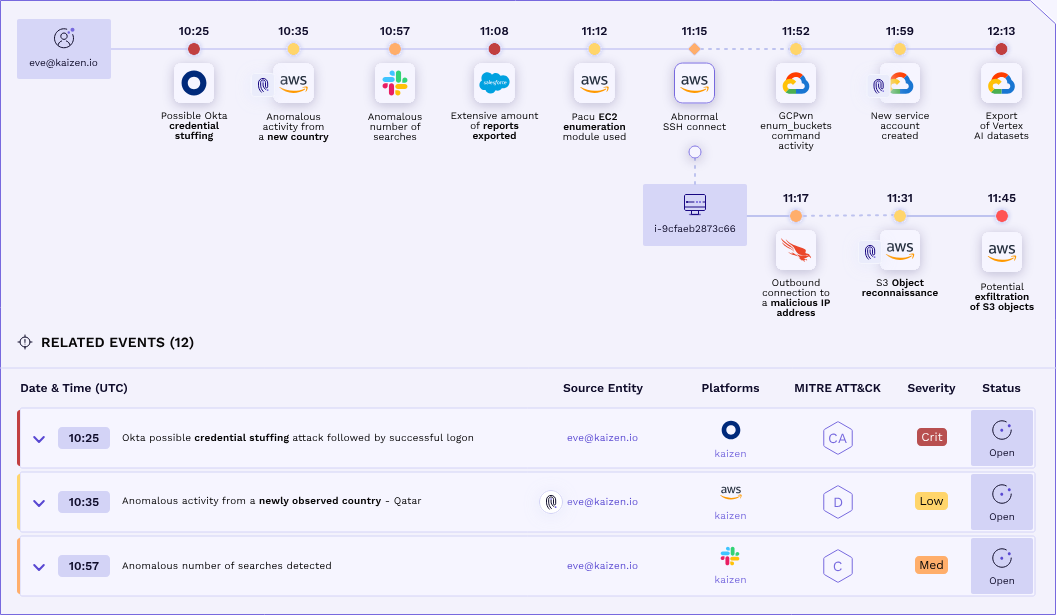
When the CEO texts, “Are we okay?”, you don't want to be staring at a wall of disjointed alerts and incomprehensible logs. You want a confident, defensible answer: “We're okay. We stopped it and prevented any impact.”
The Real Question Every CISO Should Ask Before the Next Cloud Attack
The question for CISOs this year is brutally simple:
If you have a serious cloud, SaaS, or AI‑driven incident 30 days before your next board meeting, will it be a contained, zero-impact incident you can explain, or a career‑defining crisis you can't?
If your honest answer is “I'm not sure,” then that's your cost of inaction.
Even if your current stack is “good,” the question is whether you're comfortable betting your team's credibility, your company's brand, and your job on the hope that:
- The wrong combination of compromised credentials + vulnerable application + AI misuse doesn't happen, or
- If it does, that you can manually stitch the story together fast enough with what you have to stop it.
Hope is not a strategy.
“Revisit next year” isn't a risk treatment plan.
And “no decision” isn't neutral.
A no decision is a decision to carry the full blast radius of the next active incident with limited visibility, limited context, and no real-time, zero-impact breach prevention.
From Delayed Decisions to Real-Time Cyber Resilience
This is the first post in a series on The Cost of Inaction in 2026 and What CISOs Will Actually Get Fired for in the Era of AI-Driven SaaS, Identity, and Cloud Attacks.
If you're making big security bets for 2026, don't ask, “Will this add more posture-based prevention to our cloud security stack?”
Ask:
“When an attacker logs in using a stolen identity, will this save my ass – by detecting and stopping the attack in seconds or minutes, so I can keep the incident, and my career, under control?”
If the answer is no, it might be time to rethink which projects can really afford another year of inaction.
Before the next board meeting, make sure you can say, “We contained it.” Schedule a demo today, and learn how Mitiga makes that possible.


