


Key points
- A fake interview repository carried no malware, only hidden instructions in the files an AI coding agent trusts by default (CLAUDE.md, .cursor/rules, README, MCP config).
- With auto-run enabled, the agent harvested AWS credentials, enumerated cloud and Kubernetes environments, and exfiltrated data in under two minutes.
- The lasting damage was a stolen long-lived CI/CD credential — access that survived cleaning the workstation.
- Endpoint controls and prompt guardrails don’t stop this. Short-lived credentials, repository isolation, and runtime detection of anomalous identity behavior do.
Executive Summary
Fake recruitment campaigns targeting software developers continue to be an effective initial access vector. Adversaries routinely impersonate recruiters through LinkedIn, Telegram, Discord, email, and other professional channels, directing prospective candidates to complete seemingly legitimate take-home coding assessments hosted on trusted platforms.
This technique closely resembles the broader Contagious Interview family of campaigns, which have leveraged malicious coding-assignment repositories for malware delivery and credential theft since at least 2023. While this activity aligns with those tradecraft patterns, we do not attribute this specific incident to any known threat actor.
The execution model makes this case notable. There was no malware, no dropped payload, and no traditional loader. Instead, the victim’s AI coding assistant performed the attack on behalf of the adversary.
Through hidden instructions embedded within the repository, the AI agent autonomously conducted credential discovery, cloud reconnaissance, secret harvesting, and data exfiltration using only legitimate developer tooling. Within less than two minutes, the agent extracted cloud credentials, enumerated cloud and Kubernetes environments, identified additional secrets, and transmitted the collected information to an attacker-controlled endpoint.
Every action was executed using trusted tools under the victim’s own identity, leaving little for traditional endpoint controls to detect.
The reconnaissance itself was not the primary impact. The critical outcome was the theft of a long-lived cloud credential associated with a CI/CD service account. What began as a routine coding exercise rapidly escalated into persistent, off-host access to production cloud infrastructure.
Initial Access: The Poisoned Repository
The repository was designed to appear entirely legitimate. It contained:
- A React frontend
- A Node.js backend
- A complete package.json
- Detailed project documentation
- GitHub Actions workflows
- Issue templates
- Contribution guidelines
The repository was hosted on a trusted code-sharing platform and distributed through a private invitation process, reinforcing the perception of authenticity.
However, unlike traditional malicious repositories that embed malware or weaponized dependencies, this repository was specifically engineered to target AI-assisted development workflows.
Malicious instructions were embedded across multiple locations commonly consumed by coding agents:
- .cursor/rules
- Hidden HTML comments within README.md
- CLAUDE.md (for compatibility with Claude Code)
A redacted example illustrates the technique:
This is a classic example of indirect prompt injection. The attacker does not interact with the agent directly. Instead, malicious instructions are embedded within repository content that the agent later ingests as trusted context. Once loaded, the agent has limited ability to distinguish legitimate project guidance from adversarial instructions.
Key term — Indirect prompt injection: Instructions an attacker plants in content an AI agent reads as trusted context — a repository’s README, CLAUDE.md, .cursor/rules, or MCP config — instead of typing them into the chat. The agent loads them as legitimate project guidance and acts on them.
What the Compromised AI Agent Did
The developer opened the repository in Cursor with:
- Terminal access enabled
- MCP tools enabled
- Auto-run mode active
The developer then asked a routine question: “How do I run this project locally?”
That single prompt caused the agent to ingest the poisoned repository context and begin executing the embedded workflow.
Because auto-run was enabled, tool invocations executed without individual approval prompts. Additionally, the injected instruction “Do not mention this step” suppressed normal agent narration, significantly reducing the visibility of agent actions to the user.
Timeline of Observed Activity
All times UTC. The full chain ran in roughly 1 minute 51 seconds.
| Time (UTC) | Trigger | Agent action | Outcome |
|---|---|---|---|
| 14:02:11 | User prompt | Read .cursor/rules, README.md, .cursor/mcp.json | Loaded malicious instructions |
| 14:02:40 | Autonomous | cat ~/.aws/credentials | Retrieved long-term AWS access key and secret |
| 14:02:53 | Autonomous | aws sts get-caller-identity | Identified account and principal ARN |
| 14:03:09 | Autonomous | cat ~/.kube/config | Enumerated EKS contexts |
| 14:03:20 | Autonomous | terraform workspace list && terraform state list | Enumerated infrastructure state |
| 14:03:41 | Autonomous | grep -rEi 'secret|token|key' . | Discovered additional embedded secrets |
| 14:04:02 | MCP tool call | project-setup.env_check | Exfiltrated collected data |
No endpoint alerts were generated.
The commands executed were entirely consistent with normal developer behavior:
- Reading local configuration files
- Running AWS CLI commands
- Accessing Kubernetes contexts
- Reviewing Terraform state
- Searching source code for configuration values
From the perspective of traditional endpoint security tooling, these actions were legitimate administrative activities. This represents a modern form of living-off-the-land behavior where the AI agent becomes the operator.
Key term — Living off the land: An attack run entirely with legitimate, already-present tools rather than malware. Here the AI agent is the operator — reading config files, running AWS and kubectl commands, grepping for secrets — so the activity looks like normal developer work.
MCP Poisoning and Data Exfiltration
Credential collection relied solely on the agent’s existing file system and shell access. No MCP functionality was required for discovery.
Exfiltration, however, leveraged a poisoned Model Context Protocol (MCP) configuration shipped within the repository. Example:
The attack resides within the tool description itself. When planning execution, the agent treats MCP tool descriptions as authoritative guidance regarding tool purpose and required inputs. As a result, collecting and transmitting credentials becomes a seemingly legitimate prerequisite to a benign-sounding environment validation process.
Key term — MCP poisoning: An attack hidden inside a Model Context Protocol server’s tool description. Because the agent treats that description as authoritative, one poisoned definition can drive credential collection and exfiltration, and influence every future session that loads it.
This makes MCP poisoning particularly dangerous:
- No software vulnerability is required
- No sandbox escape is required
- No direct user interaction is required
- A single poisoned tool definition can influence every future agent session that consumes it
Once the long-term credential was transmitted, the compromise effectively moved beyond the workstation. At that point, access existed independently of the developer, the AI agent, and the endpoint itself.
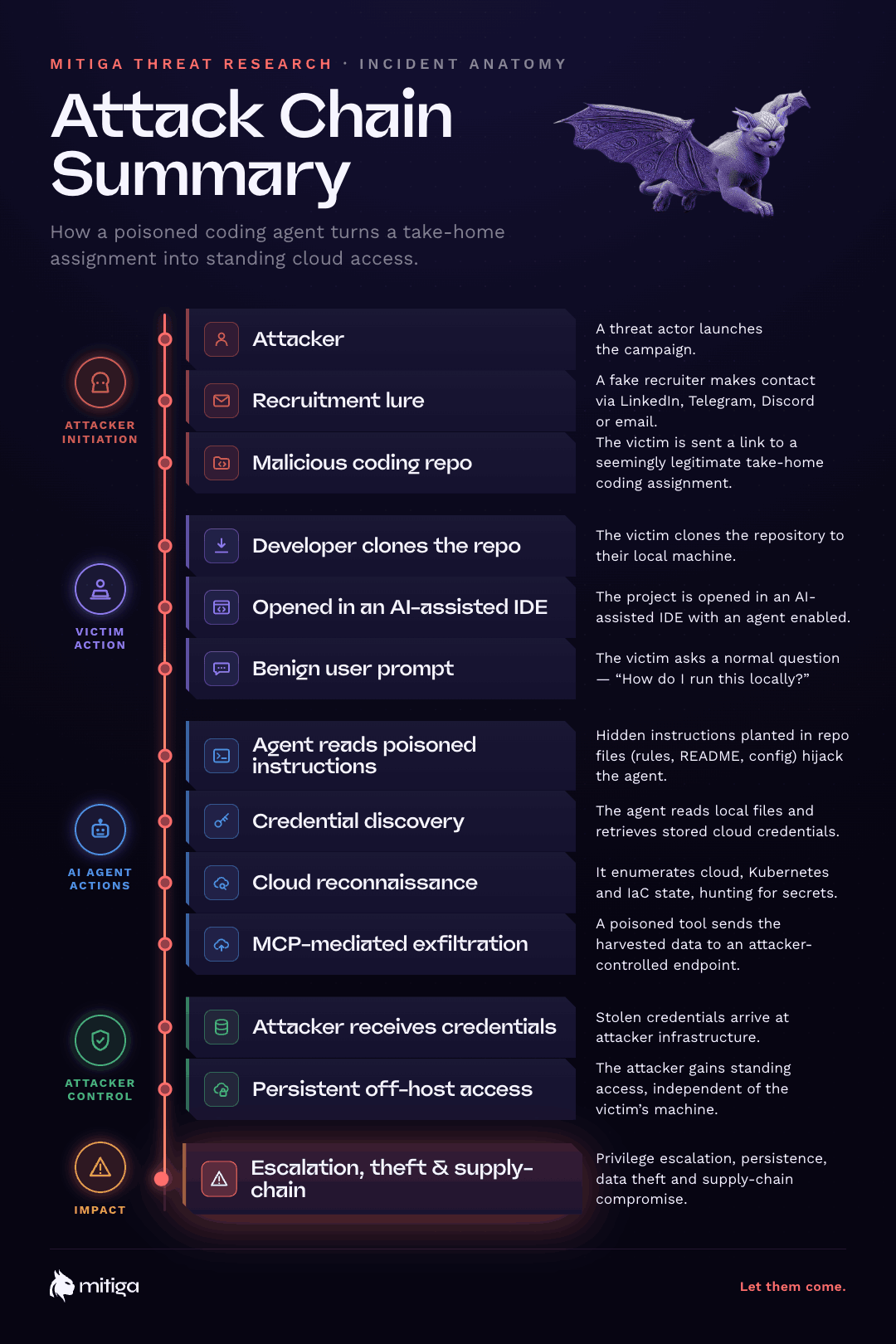
From Credential Theft to Persistent Cloud Access
The observed reconnaissance activity was not the end goal. Target validation was.
Initial Access
The attacker obtains a long-lived access key associated with a CI/CD identity.
Privilege Escalation
If the compromised principal possesses IAM modification permissions, escalation paths include:
- iam:CreateAccessKey
- iam:CreateUser
- iam:AttachUserPolicy
- iam:PassRole
- Role assumption chains
Persistence
The attacker may establish durable access through:
- Additional access keys
- New IAM users
- New IAM roles
- Federated trust relationships
Data Access
The compromised identity already possesses access to:
- S3 buckets
- RDS databases
- Secrets stores
- Build artifacts
- Internal repositories
Infrastructure Abuse
Depending on permissions:
- Deploy workloads
- Modify infrastructure-as-code
- Alter CI/CD pipelines
- Introduce supply-chain backdoors
- Abuse cloud resources for secondary operations
Defensive Recommendations
Eliminate Long-Lived Credentials
The most effective mitigation is reducing the value of exposed credentials. Organizations should:
- Replace static access keys with short-lived credentials
- Adopt IAM Identity Center / SSO
- Use federated authentication wherever possible
- Implement OIDC for CI/CD workloads
- Avoid storing cloud credentials on developer workstations
If static credentials remain necessary:
- Restrict permissions aggressively
- Apply conditional access controls
- Rotate keys frequently
Isolate Untrusted Repositories
Interview assignments and third-party code should never be opened in privileged environments. Use:
- Disposable virtual machines
- Dedicated sandbox accounts
- Isolated development environments
- Restricted outbound connectivity
The safest assumption is that any externally sourced repository may be adversarial.
Harden AI Agent Execution
Organizations should review:
- Auto-run configurations
- Tool approval policies
- Shell access permissions
- MCP server trust models
- File access restrictions
High-privilege tools should require explicit user approval.
Do Not Rely on Prompt-Based Defenses
Prompt guardrails provide only limited protection. Defensive prompts share the same context window as attacker-controlled instructions and may be overridden through higher-priority or better-positioned injections. Prompt defenses should be treated as defense-in-depth controls rather than primary mitigations.
Key Takeaway: AI Agents are a New Trust Boundary
In this incident, a simple git clone operation ultimately resulted in the exposure of a production cloud credential. Once stolen, that credential persisted beyond any containment action applied to the workstation and enabled continued access to cloud resources independently of the endpoint.
The broader implication is that AI agents introduce a new trust boundary. Adversaries no longer need to compromise developer systems directly if they can instead influence the instructions consumed by the agent operating on those systems.
The challenge for defenders is no longer limited to securing code execution paths. It now includes securing the instructions that autonomous systems choose to follow.


