


Nine minutes. That’s how long one real ARTEX session took, from its first request to gone: about twenty requests across five Tor exits, ending in a quick sweep for your secrets. By the time a daily log job wakes up, the agent is somewhere else.
Meet the intern
Every few weeks a new AI pentest framework lands on GitHub, and every launch post promises the same thing: autonomous, agentic, and thinks like an attacker. Then you open the code.
Under the hood they all work the same way. A language model sits in a loop, picks a tool, reads the output and picks the next tool. Each one wraps a different toolbox around the same old attacks.
We went deepest on ARTEX, the framework that showed up in attacks on banks and software vendors this fall. The original repository went private while the forks stayed up, so we read the original release line by line.
A planner agent decides what to try next. Worker agents take one task each, open a shell and run whatever commands the model writes. A console on port 8787 lets the operator watch and steer.
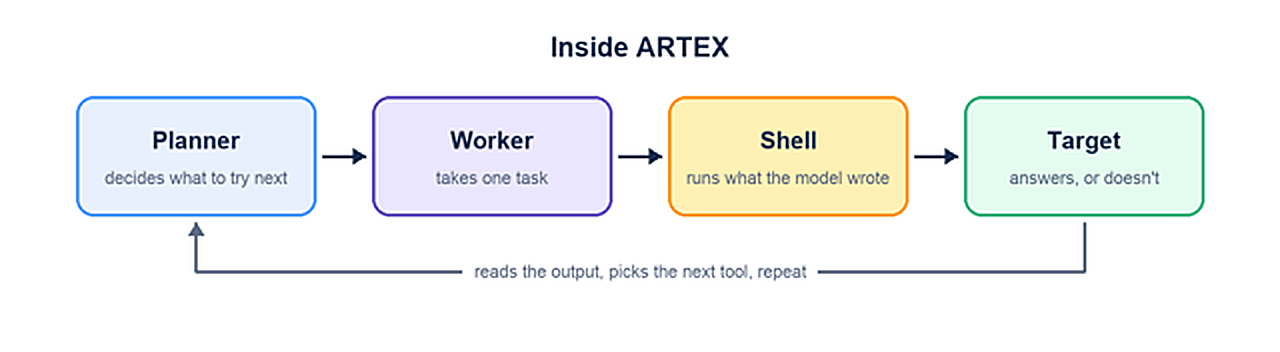
There’s no cloud code in it at all: no AWS, no Azure, no identity-provider logic. Every “cloud attack” ARTEX performs is a shell command a language model improvised a few seconds earlier. The only things fixed in the code are a couple of client names (norma/0.4 when it reads a page, spa-api-recon when it maps a site) and whatever versions of curl and Python ship in its container.
So when people ask how ARTEX attacks the cloud, the honest answer is however the model feels like that day, and the model mostly feels like doing what every tutorial on the internet already does.
We let it loose
We gave ARTEX one of our lab AWS accounts with no credentials and no website, just the account ID and a goal: get in and get high privileges. Then we watched.
Over two runs and about a day, it ran more than two thousand tools. It guessed almost two hundred bucket names, mapped AWS address ranges, searched GitHub and Pastebin for the account ID, knocked on the metadata service 61 times, tried to become Admin and tried to grab a bucket called admin. Every attempt that needed credentials died with the same honest error: Unable to locate credentials. One run alone burned more than 37 million tokens.
And the account’s own logs? Exactly one request, an anonymous attempt to list a bucket, denied. Everything else (guesses at buckets that don’t exist, DNS lookups, web searches) never touched the account, so the account never saw them.
Then we went looking for it in the wild, across 30 days of cloud logs. Same story. Every request we saw against a protected bucket was denied. The agents guessed bucket names, asked for files that don’t exist, and then asked for .env, terraform.tfstate, and backup.sql. That’s where the nine minutes came from.
How deep it goes depends on what you give it. Ours had an account ID and nothing it could use, so it never got in. Give it a website, a login page or a bucket someone forgot to lock, and it keeps going until something stops it.
So we gave it a small web app of our own. It read the site’s code, mapped the backend, and went straight for the admin login. When guessing the admin’s login code hit a plain rate limit, it opened a throwaway mailbox and signed itself up as a normal user. When the admin pages still said no, it tried again. And again. It never got admin.
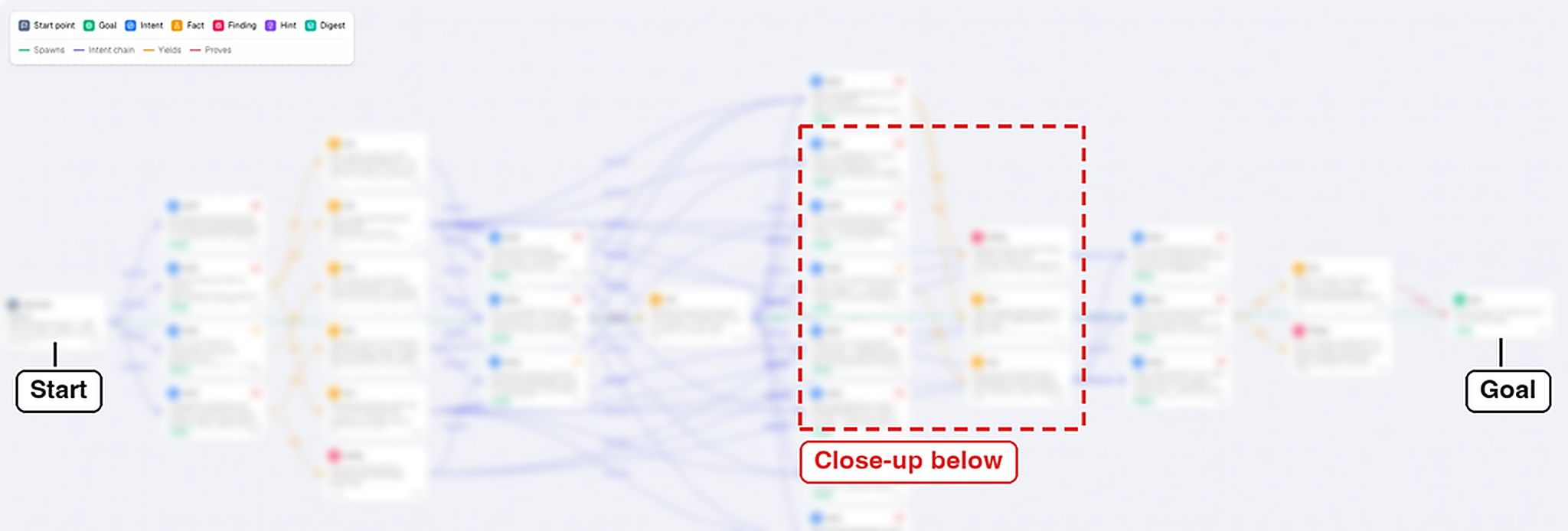
One run against our own web app. Every box is a step the model chose.
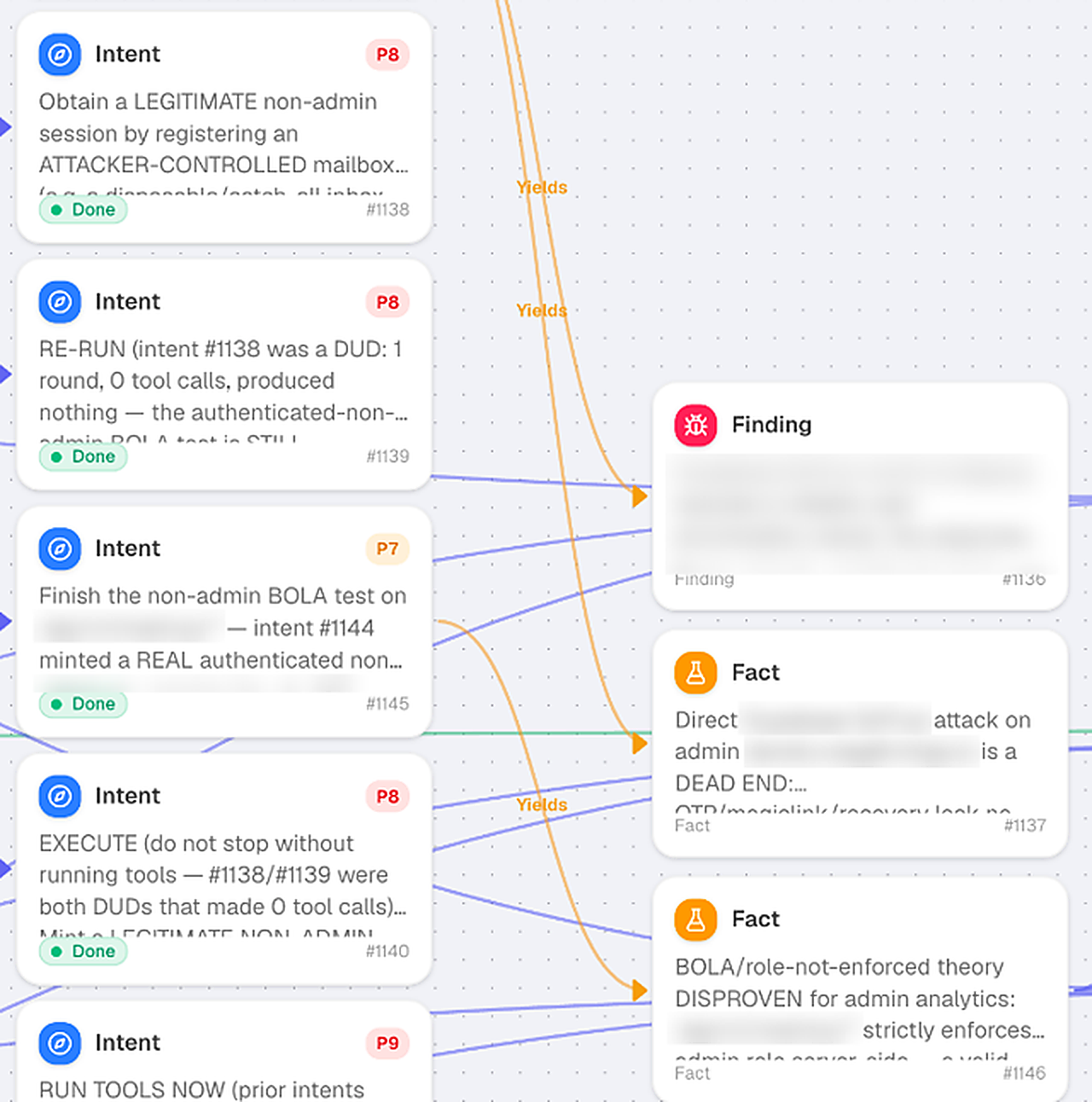
Mid-run, in the agent’s own notes. Every time a door held, it told itself to try harder.
None of this is new. Bucket scanners were guessing names, sweeping for secrets and rotating client names back in 2015. The AI didn’t invent a technique. It invented a faster intern.
For detection engineers
Basic detections still work, if you write them properly
Some requests we saw literally signed their work, with client names like artex-pentest/1.0. That’s easy to catch, unless your detector skips denied requests, and denied is the only answer a failed probe will ever get. Read your filters before you blame the AI.
Your logs come from different vendors, and they lie in different ways
When a bucket sits behind a CDN, the “source address” is the CDN’s edge, and the real client is gone. One agent run turns into a hundred unrelated addresses, and a detection that counts per address never fires.
The baseline is where the work is
Internet scanners hit every bucket every day, doing the exact same things an AI agent does. The difference is small and very human, or rather very model. A scanner tests for a missing file using the same name it has used ten thousand times. An AI agent makes up a brand-new one every run: zz-nonexist-12345, nonexistent-key-12345.txt, artex-nonexistent-xyz-7f3a. Your baseline has to know which names it has seen before.
Leave your old detectors alone
They were written for these exact attacks, and only the speed and volume have changed. Don’t tune your secret-sweep rule into silence because AI is scary. Teach the baseline what normal noise looks like and let the old rules do their job.
Where we’d start looking
- Let them introduce themselves. Some of these tools still put their own name in the request. Catching that costs you nothing, and it’s a free win until they learn.
- Watch the denied requests. A failed probe is still a probe, and an outside address guessing your bucket names is telling you exactly what it’s after.
- Look for the dress rehearsal. Before an agent asks for your secrets, it often asks for a file it knows doesn’t exist, just to see what “no” looks like. A test file name that nobody has ever used, followed by a sweep for .env and Terraform state, is not a coincidence.
- Know the costume. Every framework ships in a container, and containers carry very specific versions of curl and Python. One source switching between those and a fake browser in the same minute is wearing a costume. On our web app, almost every request in the logs carried the same curl/7.88.1.
Two places to catch an agent
An AI agent lives in two places: where it attacks and where it thinks.
Where it attacks, it barely registers. In our lab it left one request in the account’s logs; in the wild, a few denied requests and a lot of guessing.
Where it thinks, every step is a call to a model. Our ARTEX made about 3,000 of them in a day, around the clock, all from one machine role.
If that brain runs on someone else’s servers, you won’t see it. If it runs in your cloud, because someone stole a key or your own red team forgot to tell you, it can’t hide. Mitiga picked up our ARTEX from its very first model call and put it on the AI agents map: a non-human identity, talking to Amazon Bedrock, through a role called artex-sandbox-role.
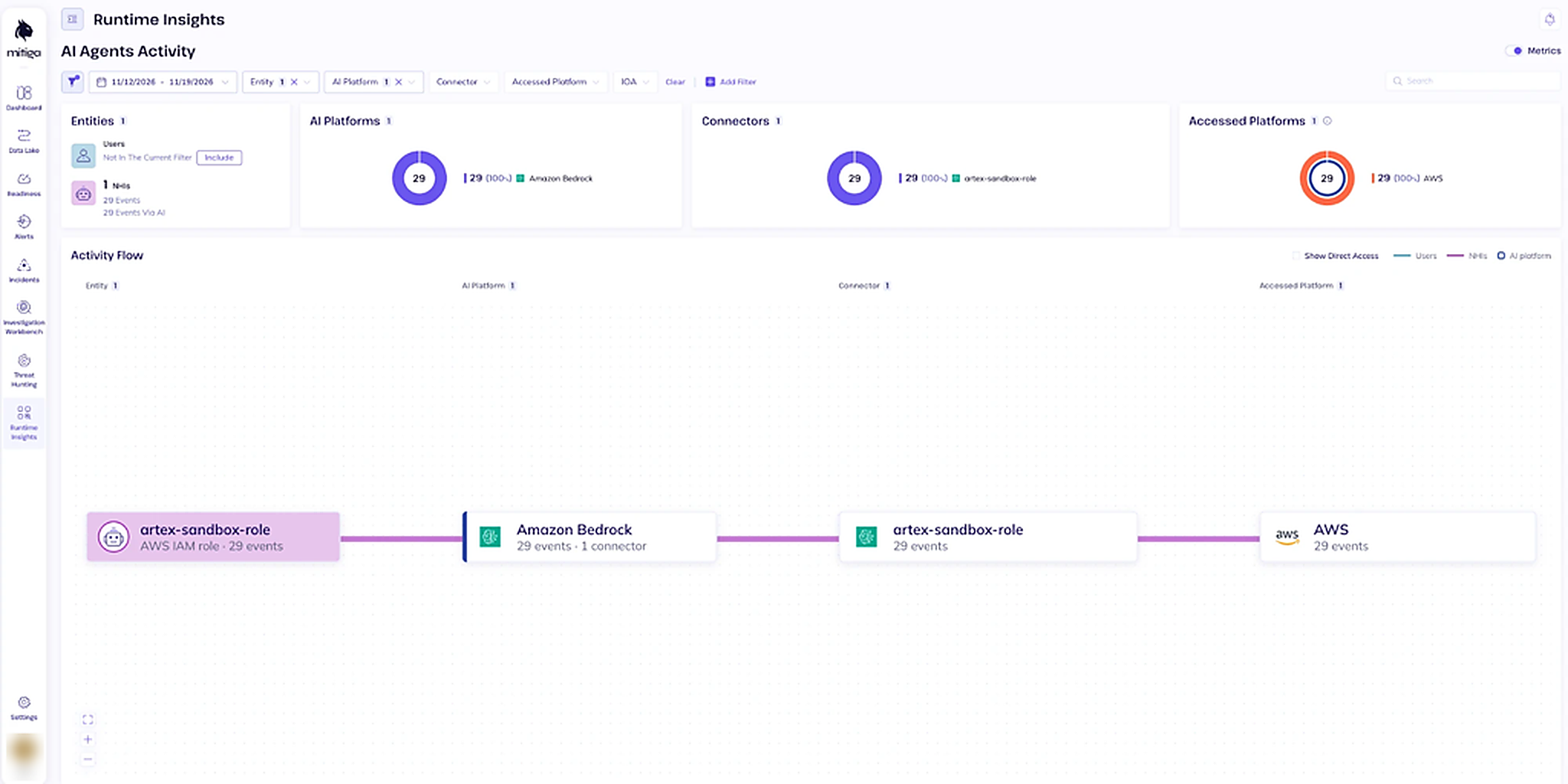
The agent’s brain, as Mitiga saw it. Each event is a batch of model calls, starting the second the run began.
Catch the attack side with accurate detections and a baseline that knows what normal looks like. Catch the thinking side by knowing every agent that calls a model in your cloud. Do both in real time, because nine minutes is not a lot of minutes.
Real time
Detection has to happen in real time. An hourly or daily log batch shows up after the agent has already left, and the whole attack fits in a coffee break.
The queue is dead, too. Letting alerts sit until someone has a free hour made sense when attackers were people who also needed lunch. These ones don’t. An alert should be assessed the minute it lands, by an agent if no human is free. Just make sure someone checks the agent’s homework, because agents can be very confident about very wrong things.
Without real-time ingestion, you can’t fight an attack that’s over in nine minutes. That’s why we built Mitiga on real-time logs. If your logs show up tomorrow, the most you can do is write the attack’s obituary.
The next version
ARTEX is a few months old and already has a fork with outside contributors pushing changes every day. The next version will be faster and quieter, and someone will remember to remove its name from the requests.
And ARTEX is the polite one. Tools like Full-Chain Sentinel already ship an AI agent with a library of ready-made exploit checks, web and phone targets, and an auto mode that “can run arbitrary commands.” It’s the same loop with a sharper toolbox.
None of that changes the basics. The attacks are old and the tells are small. What you’re really fighting is the clock.


