


Key points
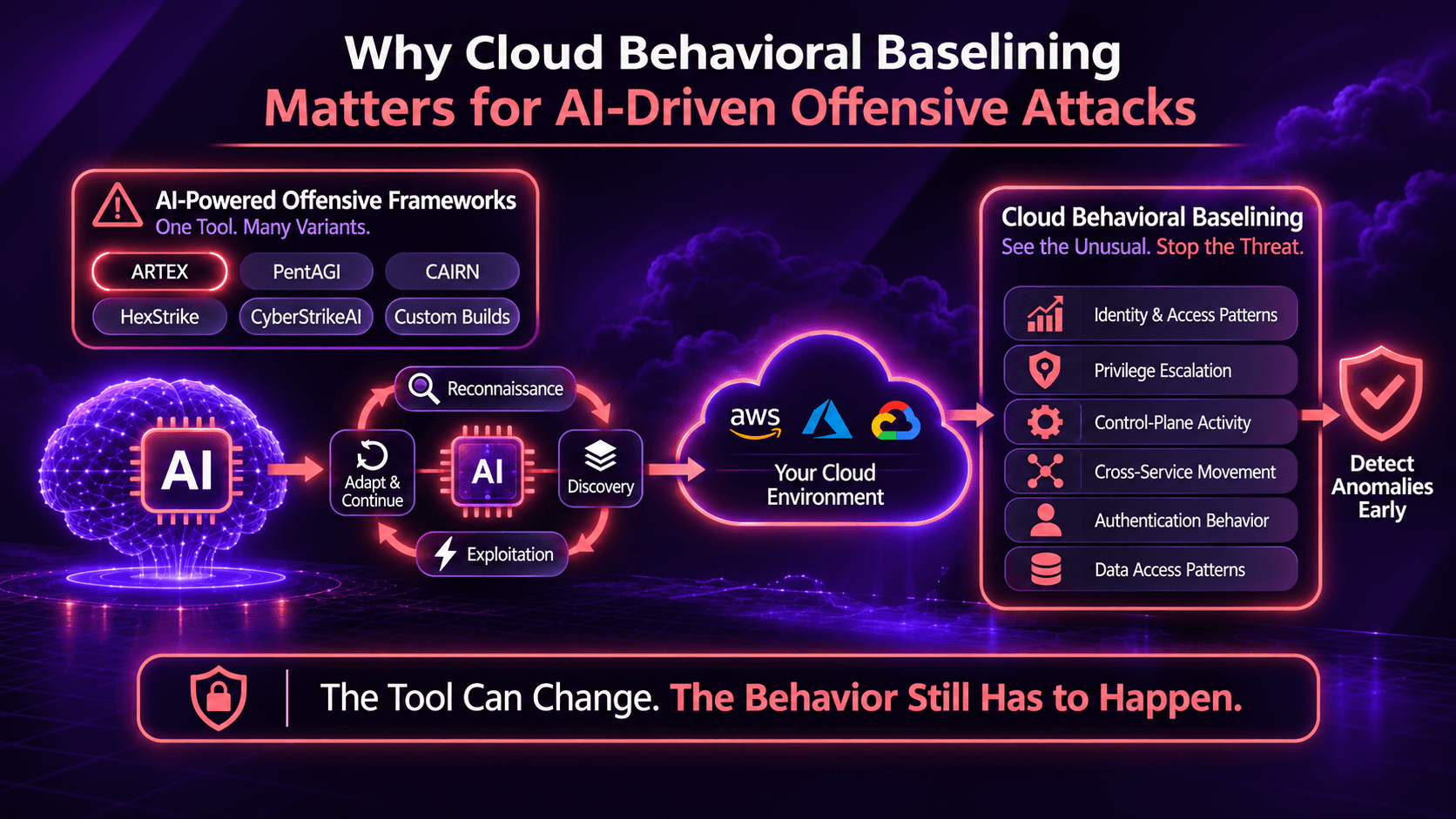
- ARTEX is one of several agentic offensive frameworks now showing up in real intrusions, alongside PentAGI, CAIRN, Hexstrike, and custom builds.
- Forks, swapped models, and rotating infrastructure make framework-specific signatures fragile.
- What an attacker has to do inside your cloud doesn’t change with the tool. Baseline identity and control-plane behavior, and the activity stands out even when the framework is new.
On Oct. 30, 2026, Google Threat Intelligence Group (GTIG) published its analysis of threat actors running ARTEX in live intrusions. One ARTEX execution sequence produced 27 events in 23 seconds.
That speed is the headline. The framework hands most of an attack chain, from reconnaissance through exploitation, to AI agents that need far less human steering than a traditional toolkit. ARTEX is one framework among several, and GTIG names PentAGI, CAIRN, and Hexstrike alongside it. CyberStrikeAI and a long tail of custom builds work the same way: 1) wire an LLM to established security tools, 2) let the agents read the output, and 3) have them choose the next move until they reach an objective.
The detection that lasts comes from knowing your cloud well enough that automated reconnaissance, privilege escalation, and control-plane abuse stand out, whoever built the tool.
An orchestration layer over old tools
ARTEX can be considered an agentic offensive framework, which is kind of like an LLM connected to security tooling, and running a loop like the below:
Objective → Plan → Execute → Observe → Adapt → Continue
A script follows its fixed path and stalls when something unexpected comes back. An agent reads the error and tries again. In one case that GTIG documented, an ARTEX-deployed webshell failed and the framework appears to have refactored its approach and gone back in. Although Nmap, Nuclei, Metasploit, and the cloud CLIs have been around for years, ARTEX adds the orchestration, and the pace at which it chains them together.
Speed and scale
A human operator works one promising system at a time. An agent framework can probe many at once, read the results, and keep chasing a path without waiting for anyone to approve the next step. GTIG measured individual ARTEX sequences running in bursts of roughly 2 to 25 seconds and saw attackers move from a first compromised account to deep system access in about four hours, in one case 15 minutes. The same headcount can now drive far more attack paths at once.
Forks break signatures
ARTEX’s creator took the original repository down in October 2026 because of widespread abuse by threat actors. The code kept spreading anyway, through forks that include a localized variant called ScopeWeaver and a commercial version called ARTEX PRO.
Attackers can change the source, swap the model, rewrite prompts, move infrastructure, or mix frameworks. “Is this ARTEX?” stops being a useful question quickly. “Does this look like automated offensive activity?” holds up.
Framework names die fast. So do User-Agents, specific headers, IPs, and domains. They still help with enrichment, but an attacker can change or strip every one of them, and GTIG’s own assessment is that static indicators “will not cover much of this activity.”
How to implement cloud behavioral baselining
If one swaps the framework or the model or the infrastructure, it doesn’t change what an attacker has to do once they’re inside: enumerate, escalate, touch the control plane, reach data. All of it lands in your logs. ARTEX left a plain example in AWS, testing compromised IAM permissions with DryRun flags and placeholder IDs to see what it could do with EC2, EBS volumes, and snapshots before committing to anything.
1. Get the foundations right
- Enable and centralize the right logs: AWS CloudTrail (management events, plus data events where useful), Microsoft Entra ID audit and sign-in logs, GCP Audit Logs, and the equivalents for any other cloud or identity provider you run.
- Build a basic identity inventory. Know which service accounts, roles, workload identities, and human accounts exist. Then understand what each of them is supposed to do, and who owns it. Non-human identities deserve the most attention.
- Pick a look-back window to set initial baselines. Thirty to 90 days is common.
2. Baseline what agentic attacks touch
- Map which identities call which APIs, from which source IPs or network locations, against which resources. A sudden run of List*, Describe*, and Get* calls from an identity that used to do one narrow job is a strong signal.
- Track normal role assumption, and flag identities that start assuming roles they rarely or never use, or chain several assumptions in a short window.
- Watch for rapid or unusual changes to IAM, storage, secrets and key vaults, compute, networking, and logging configuration, especially outside normal change windows or from someone other than the usual owner.
- Know which services and accounts normally talk to each other. New pairings are worth a look.
- Look for abnormal authentication volume, unfamiliar source locations or ASNs, and sessions that go from login to broad administrative API use within minutes.
- Notice spikes in object listing, large-scale reads, or new export and snapshot resources. They often mark the move from discovery to collection.
3. Turn baselines into hypotheses, then detections
Start with a hypothesis you can prove wrong. For example, a non-human identity with a narrow baseline is being driven by an agent framework, probing its own permissions before it escalates. If that were happening in your environment right now, you would expect to see:
- First-seen or rare API combinations for that identity, often permission checks before any write.
- A volume jump, like an identity that normally makes dozens of calls a day suddenly making thousands.
- A sequence shaped like discovery → credential access → privilege escalation → data access, with seconds between steps instead of minutes.
- The same calls looking routine for one identity and alarming for another, which is why identity context has to join network and resource context before anything pages someone.
When the hunt confirms the pattern, turn it into a detection. Many teams begin with native detections, such as GuardDuty’s anomalous-behavior findings or Entra ID Identity Protection risky sign-ins, then layer custom logic in their SIEM, XDR, or cloud analytics tools.
4. Keep it running
- Treat service accounts and workload identities separately from people. Their baselines are narrower and easier to predict.
- Account for legitimate automation and deployments so you aren’t retraining on every expected change.
- Review and tune on a schedule. Baselines drift as systems and teams change.
- Start with high-privilege, high-blast-radius identities. Coverage on day one doesn’t have to be complete.
Even with baselines in place, a tool you’ve never seen can still surface. These include a service identity enumerating hundreds of resources, a workload sending reconnaissance-style requests to internal services, and a single source running discovery, exploitation, and privilege changes in quick succession. None of it needs the string “ARTEX” anywhere in the logs.
After ARTEX
GTIG notes that these frameworks currently “trade stealth for velocity,” which makes them loud today. Expect that trade to improve for attackers as the forks mature.
Build the next hunt around behavior. If an agent framework were working through your environment right now, you would expect autonomous reconnaissance, an attack chain with seconds between steps, and identity or control-plane activity that falls outside the baseline. Write detections for those, then confirm they still fire after the attacker swaps frameworks, because the attacker will.
ARTEX is an early, well-documented step from AI-assisted hacking toward more autonomous offensive operations. Chasing each new framework one at a time is a losing schedule. Baselines around identities and the cloud control plane hold up, and every hunt you run against them should end in a detection you can run again.
The tool can change.
The behavior still must happen.


