

Mitiga Mean Time to RespondDetect in seconds. Respond at machine speed.

Powered by Helios AIDR and the Helios Fleet of agents, Mitiga delivers MTTR at the speed attackers move, from event to triage, to actionable response in under 3 minutes.

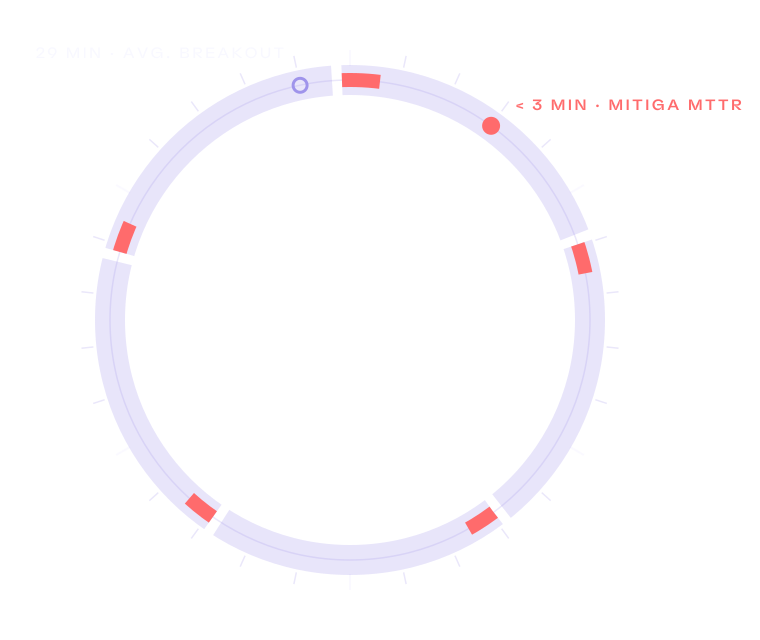
A dial measuring a 30-minute window. Mitiga's detection completes in the first 3 minutes; the average attacker breakout lands at 29 minutes.

What is Mean Time to Respond?

Mean Time to Respond (MTTR) is the time from an event to an alert an analyst can act on, including vendor delay, collection, and triage. Every result is enriched and AI-triaged before it ever reaches your team.

What the clock counts

The MTTR timeline

<3 minSources CloudSaaSIdentityAI
  1. 01Event landsClock starts
    • Cloud, SaaS, identity, AI
    • Third parties
  2. 02Vendor delay
    • Counted in MTTR
    • Before the event reaches Mitiga
  3. 03Collection
    • Event-driven pull every minute
    • Or pushed by vendor
  4. 04Detection
    • Single-event detectors on the stream
    • Behavioral detectors on hourly windows
  5. 05AI triage
    • Identity, asset, and history
    • Severity set, noise closed
    • Incident stitched
  6. 06Actionable alertClock stops
    • SIEM, SOAR, ticket, or chat
    • Response action attached

The problemAttackers already move at machine speed. Most SOCs don’t.

The time from initial access to lateral movement is measured in seconds. Legacy detection pipelines, with batch scans, daily posture checks, and manual triage, aren’t built to keep pace. By the time a human analyst opens the alert, the attacker has already moved on.

Detection vs. breakout
  • Mitiga MTTR · <3 min
  • Avg. breakout · 29 min
TYPICAL CLOUD DETECTION & RESPONSE
1-2 hours

Standard mean time to respond

INDUSTRY TARGET MTTR
15 minutes

The goal MTTR for most organizations

THE NEW MITIGA STANDARD
Under 3 minutes

MTTR at machine speed

Sources: Mitiga platform data · CrowdStrike 2026 Global Threat Report · Sysdig 2026 Usage Report

The answerMitiga’s new detection pipeline cuts MTTR to under 3 minutes

For real-time detections, the alerts that make up the majority of day-to-day SOC activity, Mitiga detects, enriches, triages, and delivers to your team in under three minutes, start to finish.

This is a new architecture, built from the ground up for the infrastructure attackers target across cloud, SaaS, identity, and AI. Machine-speed detection for complex, pattern-based detections that need hours of accumulated data will follow.

02.1

How we get to under 3 minutes

Mean Time to Respond (MTTR) is the time from an event to an alert an analyst can act on, including vendor delay, collection, and triage.

  1. Your sources

    0:00

    Cloud, SaaS, identity, AI, third parties. Event-driven pull every minute, or pushed by vendor.

  2. Detectors

    0:40

    Single-event detectors run on the stream as each event lands, under 3 minutes from data arrival. Behavioral detectors run on hourly windows.

  3. Enrichment and AI triage

    1:20

    Identity, asset, and history pulled from the forensic data lake. Severity is set, noise is closed, and the incident is stitched as it arrives.

  4. Your SOC and response

    <3:00

    Triaged alert in your SIEM, SOAR, ticket queue, or chat, with a response action attached and auto-run where you allow it.

02.2

What lands in your queue

From event to triaged, actionable alert. One illustrative response, start to finish.

Before it reaches your team
  1. 00:32

    Enriched

    Identity, asset, and history pulled from the forensic data lake.

  2. 01:05

    Severity set, incident stitched

    Severity is set, noise is closed, and the incident is stitched as it arrives.

  3. 01:48

    AI-triaged

    Triaged before it ever reaches your team, with an auditable verdict.

  4. 02:20

    Response attached

    Response action attached, auto-run where you allow it.

  5. 02:41

    Delivered

    Delivered to your SIEM, SOAR, ticket queue, or chat.

HighTriaged in 02:41Illustrative

AI model key used from outside the company

Single-event detector · AI · Identity

  • Identity
  • Asset
  • History
Incident
Stitched into 1 incident · noise closed
Verdict
Escalate to analyst Auditable reason attached
Response
Suspend key · reversible

Delivered to SIEMSOARTicketChat

Built to empower the AI SOCHuman on the loop. Human in the loop.

An AI SOC is a collaboration between multiple agents. Helios Fleet is the detection and response specialist in that collaboration, built for the infrastructure attackers target across cloud, SaaS, identity, and AI. Your AI SOC effort gets a foundation to build on.

Every result is enriched and AI-triaged before it ever reaches your team.

Each with an auditable verdict.

AI triage
100
%

of alerts triaged

Before they ever reach your team.

Human on the loop
95
%

of SOC workflow automated end-to-end

At machine speed, each with an auditable verdict.

Human in the loop
5
%

resolved alongside your analysts

In ~10 minutes on average, up to a board-ready report.

Featured · Mitiga LabsHugging Face Agentic Attack: We Ran It Against Ourselves

The Hugging Face-style agentic attack simulation replays a real-world AI supply chain intrusion step by step, and shows where Mitiga detects, investigates, and contains it.

On the page

Insight Brief
The full step-by-step simulation, modeled against Mitiga

Webcast
Ariel Parnes, Brandon Allen, and Brian Contos walk the attack

Free tabletop exercise
Simulate the same kind of attack against your own environment

How it worksMeet Helios Fleet: six AI agents, one data layer, one mission

Helios Fleet is Mitiga’s system of six specialized AI agents. Each owns one SOC job. All six share one memory and run on one normalized data layer spanning cloud, SaaS, identity, and AI, so every handoff carries full context.

Together they cover the entire threat lifecycle at machine speed, from prepare through detect and analyze, contain and recover, and learn and prevent. Every case feeds back into better detections.

Helios Fleet · System mapSelect an agent to see its job, its question and its target outcome
  • Handoff
  • Acts in production
  • In focus

01Prepare

02Detect & analyze

03Contain & recover

04Learn & prevent↺

“Which global threat campaigns am I exposed to, and have I already been hit?”

Scans threat intel for emerging campaigns relevant to your environment, then hands Hunter a tailored hunt and Forge new detections.

Target outcome

Validate your exposure to every relevant threat campaign, and protect against it.

“Is this happening in my environment right now?”

Turns a plain-language question, “Is anyone using our AI model keys from outside the company?”, into a threat hunt across cloud, SaaS, identity, and AI.

Target outcome

Any hypothesis answered within hours, with findings and next steps.

The AI triage step in the under-3-minute pipeline

“Which alerts need escalation, to AI or human, and why?”

Investigates every alert around the clock, the AI triage step in the under-3-minute pipeline, and escalates only those that need an analyst.

Target outcome

100% of alerts triaged, 95% resolved with an auditable action and reason, at 3× human-led coverage.

“What happened, how far did it spread, and what do we do next?”

Investigates and responds alongside your analysts in plain language, including leads from third-party tools, built on Mitiga’s incident response heritage.

Target outcome

Escalated cases resolved in ~10 minutes on average, up to a board-ready report.

The only agent that touches production

“Can we stop this now without breaking production, and clean it up after?”

Contains threats with the smallest possible blast radius, reversibly, with no privileged access of its own, through your SOAR and ticketing.

Target outcome

Reversible, non-destructive containment safe to automate; eradication and recovery run on your analysts’ approval.

Your environmentYour SOAR & ticketing

Production boundaryReversible actions run on the loop. Irreversible ones wait for your approval.

“Are my detections still catching what matters?”

Builds, tunes, and retires detections continuously, personalized to your environment without generic alerts en masse.

Target outcome

Detection gaps closed in hours. Noisy detections tuned in minutes; suppression backlog eliminated.

One memory. One normalized data layer.Every handoff carries full context.

  • Cloud
  • SaaS
  • Identity
  • AI

Six agents decide. One acts.

Responder is the only agent that touches production, with no privileged access of its own, working through the SOAR and tools you already run. Reversible actions run on the loop. Irreversible ones wait for your approval.

FAQsFrequently asked questions

What does Mitiga count as Mean Time to Respond?

+

The time from an event to an alert an analyst can act on, including vendor delay, collection, and triage. Every result is enriched and AI-triaged before it ever reaches your team.

Real-time detections, the alerts that make up the majority of day-to-day SOC activity. Single-event detectors run on the stream as each event lands; behavioral detectors run on hourly windows, not daily batches. Machine-speed detection for complex, pattern-based detections that need hours of accumulated data will follow.

Six agents decide. One acts. Responder is the only agent that touches production, with no privileged access of its own, working through the SOAR and tools you already run. Reversible actions run on the loop. Irreversible ones wait for your approval.

An AI SOC is a collaboration between multiple agents. Helios Fleet is the detection and response specialist in that collaboration, built for the infrastructure attackers target across cloud, SaaS, identity, and AI.

The Hugging Face agentic attack simulation replays a real-world AI supply-chain intrusion step by step, and shows where Mitiga detects, investigates, and contains it.

Still have a question? Ask us in a demo

Zero-Impact Breach Prevention at machine speedSee Helios Fleet in action.

Six agents, one data layer, and a detection pipeline that delivers in under 3 minutes. See what it finds in your environment.

Let them come.