


Supply chain attacks compromise downstream organizations by exploiting trusted third-party integrations. ShinyHunters breached Rockstar Games by first compromising Anodot, a SaaS analytics provider with authenticated access to customer Snowflake environments. The attackers stole service account tokens, logged in as legitimate users, and exfiltrated 78.6 million records containing financial data and player spending metrics. No vulnerability in Snowflake itself was exploited. The attack succeeded because legitimate credentials defeat detection systems designed to catch unauthorized intrusion attempts.
Key Takeaways
- Attackers don't break in anymore. They log in using stolen credentials from compromised third-party providers.
- Service account tokens provide legitimate, trusted access that evades detection systems designed to flag unauthorized access attempts.
- Third-party integrations receive broad permissions to function effectively. When the integration is compromised, all downstream environments become vulnerable.
- The Rockstar attack moved from initial access to data publication in less than two weeks. You must detect and contain this in days, not weeks.
- Supply chain attacks happen through trusted credentials, not unauthorized access. Your detection must watch service accounts, not just intruders.
ShinyHunters have gained recognition in the last few years as very reliable when it comes to compromising environments and data breaches. So far, their list of compromised companies includes multiple names from the Fortune 500. Most recently it was confirmed that Rockstar, the video game developer behind the Grand Theft Auto series, had been affected after Anodot disclosed a data leak from its Snowflake instance.
This has left many organizations and security teams worried: Will GTA 6 be delayed? But more importantly: Are we covered for a Snowflake data breach? Do we collect the right logs? Do we have anomalous detection mechanisms in place? Who's in charge of this?
Before we jump in, let this be a reminder: tactical threat hunting matters.
Snowflake Data Breach Timeline: When, What, Where?
- April 4, 2026: Anodot's public status page showed a broad outage, stating that all data collectors were down. The named impact included Snowflake, S3, and Kinesis.
- April 7, 2026: BleepingComputer reported more than a dozen companies were hit by data-theft attacks after a SaaS integration provider was breached and authentication tokens were stolen. The supply chain was hit yet again, and major companies were immediately at risk.It wasn't limited to Snowflake customers. Reports also claim that Salesforce was again targeted and the attackers tried to pivot into Salesforce, too. However, additional reports say the attack was "successfully" detected and access was prevented. Details are murky.
- April 11, 2026:ShinyHunters posted their demands on their dark-web site. Deadline: April 14, 2026.
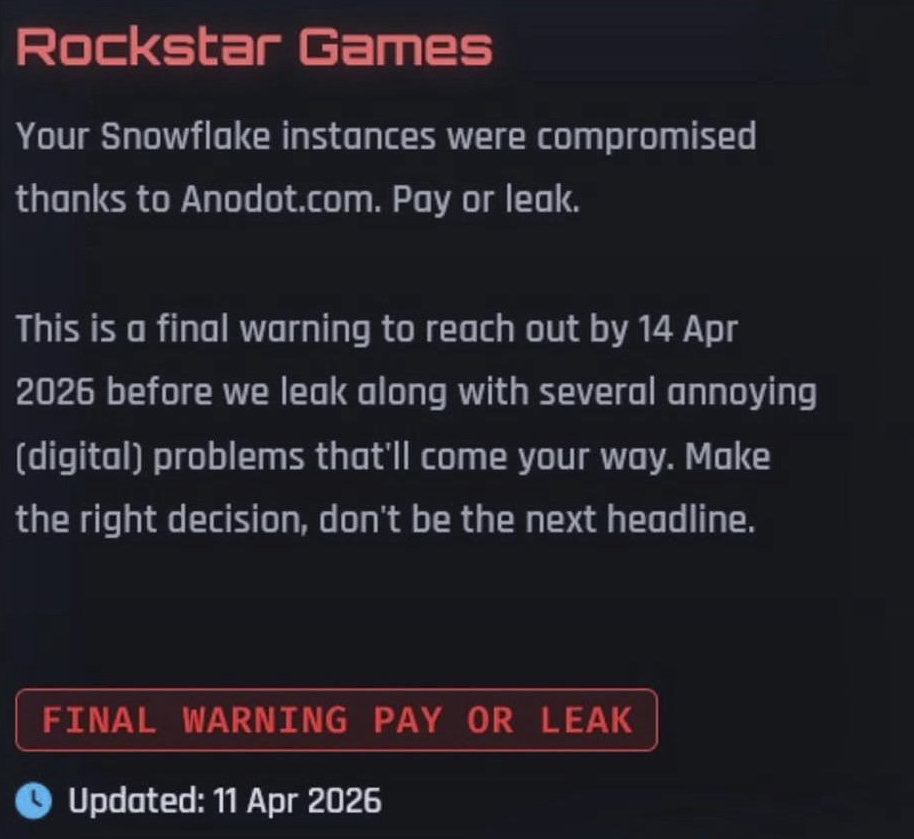
- April 12, 2026: With Rockstar refusing to pay, ShinyHunters published 78.6 million records on their dark web marketplace. The leaked data includes detailed revenue breakdowns and internal business metrics.
Rockstar responded along the lines of "The group claims to have gained access to Rockstar Games' financial data, player spending habits, marketing timelines, and contracts with outsourcing companies." The company added that "a limited amount of non-material company information was accessed in connection with a third-party data breach" and that there was "no impact on our organisation or our players."
What happened to Rockstar?
It's not just Rockstar. More organizations may be impacted today, tomorrow, or in the coming weeks.
When we put the pieces of the puzzle together, the image is still a bit blurred, but the outlines are visible:
ShinyHunters gained access to Anodot, a third-party contractor providing analytics on its clients' collected data. As we've learned from previous incidents, patient zero is almost always abused to continue a chain of compromised organizations. Just like the Drift's incident, ShinyHunters stole authentication tokens from Anodot. Using those tokens, they simply started "selecting" data and exporting it, silently and seamlessly. The company's services, plus Rockstar's, confirms it.
How ShinyHunters compromised Rockstar Games through Snowflake
From what we know, correlating the publicly available information, patient zero was Anodot. ShinyHunters had unauthorized access, unclear exactly why, when, or how and that access appears to have been both broad and privileged.
This allowed them to collect authentication tokens for service accounts belonging to Anodot's clients. As of now, no public indicators of compromise (IOCs) have been released. However, it's crucial to understand ShinyHunters' commonly observed infrastructure. This includes:
- Untrusted VPN nodes (Mullvad in particular)
- Tor exit nodes
- Unknown Cloud Providers IP addresses
- Known IOCs from incident reports of the last year or so
After collecting those authentication tokens, the group continued compromising additional victims in the supply chain. This, of course, includes Rockstar, using service account tokens deployed in its environment (or a third-party contractor's environment on Rockstar's behalf) to exfiltrate more and more data from other organizations.
Attackers do NOT break in. They LOG in.
Anodot was compromised initially, so the very first intrusion was allegedly a true "break-in." But from that point on, just like in the Drift incident, hundreds of companies were compromised by a group that simply logged in.
Why Supply Chain Attacks Target SaaS Integrations
This incident reflects a broader trend targeting SaaS integrations. Supply chain attacks target trust relationships. Traditional security controls focus on preventing unauthorized access but struggle when attackers use legitimate credentials from compromised upstream providers.
Third-party integrations often receive broad permissions to function effectively. When those integrations are compromised, attackers inherit legitimate access patterns that blend with normal business activity.
Companies reported up to $3 million in direct financial consequences from Snowflake-related breaches alone. The downstream business impact often exceeds immediate incident response costs.
How to Act Today Before Extortion Begins
Before extortion begins, tactical threat hunting can identify compromise indicators. Focus on these vectors that enabled the Rockstar and Snowflake data breach:
- Token hygiene: Stolen tokens are dangerous because they can bypass the usual controls that people expect to stop account takeovers, especially service accounts that have long-lived, broadly scoped, not sender-constrained and rarely even monitored (NHI, anyone?).
- Over-trust: A third-party integration is often overlooked. Classic delegated trust problem.
- Visibility: When a trusted connector accesses Snowflake, its traffic can look normal unless you're monitoring for subtle changes. In other words, Collect, Detect, Respond.
Visibility requires active monitoring. Trusted connector traffic appears normal unless you monitor for subtle behavioral changes in established integration patterns.
Detect it/Hunt it: Start with Known Infrastructure
- Check whether you use Anodot. If you do, start there. This can save you a lot of time versus doing behavioral analysis on logs that are barely understandable at scale.
- Start with "dry" indicators. Use heuristic, signature-based, and black-and-white IOCs. Focus on the IP addresses and infrastructure already published in incident reports, and cross-reference with the indicators listed above.
- Baseline your service accounts. What are your service accounts actually doing? Are they monitored? Do you know what permissions they have? How "aggressive" do they look in your logs?
Detection Scripts: Service Account Compromise Indicators
Once you have that baseline in place, here are a few detections you can implement in your SIEM immediately. Any LLM can help convert these into your preferred detection language and schema.
1. Integration Anomalous Login - PySpark
Requires: An anomaly-detection engine, ideally one that provides context for which IP addresses are being used.
This would help you find those unrecognized IP addresses for service accounts, which is completely not expected.
2. Snowflake Detection: Service Account External Stage Creation
These events are notable because external stages are commonly used as a prerequisite for moving data out of Snowflake, meaning this activity can indicate potential data exfiltration setup.
3. Database Reconnaissance Burst with New Session
This one, a strong one, indicates sessions where a user rapidly performs database reconnaissance immediately after starting a session.
Tactical threat hunting matters because by the time ShinyHunters posts a deadline, it's already too late.
Supply chain attacks target trust, not vulnerabilities. Mitiga goes beyond posture management to deliver continuous Cloud Threat Detection Investigation and Response across your entire SaaS and cloud stack. Ensure your Snowflake environment is protected by AI-native security.
Start threat hunting now.


